You built the business. Somewhere along the way, the business started running on you.
Not on a system. On you. Your memory. Your judgment. Your phone at 9pm. If you left for ninety days, you already know what would happen. That is the problem a business operating system solves.
Let me ask you this. When a decision gets made in your company, where does it get made? When a new hire learns the job, what do they learn from? When the week starts, what sets the rhythm? For most founder-operators running a $5M to $12M business, the honest answer to all three is the same. You. That is not a system. That is a captain holding the whole ship together by hand.
Here is the thing. There is a name for what you are missing, and there is a way to install it.
So what is a business operating system?
A business operating system is the set of repeatable parts that let a company run on its own design instead of its owner’s nervous system. It is how work gets decided, who owns it, and the rhythm that keeps it moving, all written down and running without you in the room.
Think of it the way you think of a ship. A ship does not hold its course because the captain grips the wheel every second. It holds course because the heading is set, the crew knows their stations, the watch rotates on schedule, and the captain commands from the bridge instead of running below deck to patch every leak. Take that captain off the ship for a week and it still sails.
That is the outcome we are after. A company that holds its heading without your hands on the wheel.
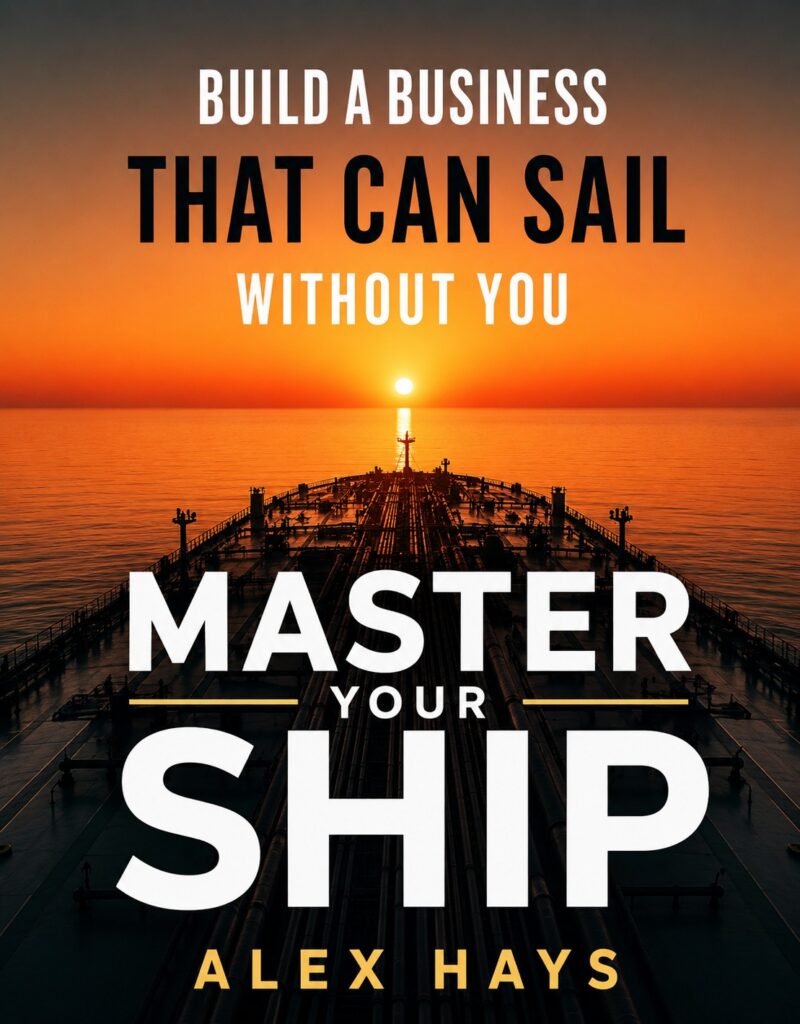
You have met this idea before. Traction calls it an operating system. Scaling Up built a set of tools around it. Clockwork teaches you to design the business to run itself. They are all pointing at the same target (a company that runs on structure, not on the founder). Master Your Ship teaches it from the bridge, written by someone who has run the operation, not only advised it.
Why most $5M businesses do not have one
Because they never needed one to get here.
You crossed the first few million on hustle, instinct, and long hours. That worked. It is supposed to work. The trouble is that the same thing that got you to $5M is the thing that pins you there. You became the operating system. Every real decision routes through your head, because that is where the knowledge lives.
So the company grows, and instead of getting freer, you get more tangled. Revenue climbs. The load climbs faster. You own something worth millions on paper and you cannot take a clean week off. That is the cash-poor, net-worth-rich trap, and nearly every operator in the $5M to $12M range feels it in their chest.
The reality is you do not have a growth problem. You have a structure problem wearing a growth costume.
What are the four parts of a business operating system?
A real operating system has four parts. On a ship they carry names any captain would recognize.
- Course. Where the ship is going. The direction, the priorities, and the few numbers that tell you whether you are on heading or drifting.
- Crew. Who runs the ship and the seats they operate inside. Clear ownership, clear standards, and no confusion about who holds what.
- Cadence. The rhythm that holds it together. The reviews and check-ins that run on a schedule, instead of running only when something breaks.
- Command. The captain on the bridge. How you lead, decide, and hold the line without becoming the person who does every job.
Course, Crew, Cadence, Command. Four parts stacked on one another. Go weak in one and the others start to strain. Go strong in all four and the ship runs.
How do the four parts connect?
The parts are not a menu you pick from. They are a sequence, and the order is the whole point.
It runs like this. Discipline creates clarity. Clarity creates systems. Systems create outcomes. Outcomes create freedom.
Read that again, because most owners try to jump straight to the last word. They want the freedom now. But you cannot see the business clearly while you are reacting to it all day, so discipline comes first. You cannot build a system around something you have not named, so clarity comes next. Systems are what turn a good intention into a result you can repeat. And the freedom, the part you actually want, is the dividend that shows up after the work, not the seat you start in.
Skip a link and the chain breaks. That is why a shelf full of business books never fixed it. The ideas were fine. The order and the discipline to install them were missing.
How do you tell if your business is missing one?
You do not need a fancy assessment to know. You need one honest hour. Look for these signs.
- The business cannot run for two weeks without you reachable.
- New hires learn the job by shadowing you, not by reading how it is done.
- The same problems return every quarter and get solved the same heroic way.
- You are the tie-breaker on decisions that should never reach your desk.
- Your calendar is full and your priorities are not moving.
- Growth has made the operation feel worse, not better.
If three or more of those sound like your week, the company is running on you, not on a system. Which is huge. It means the ceiling you keep hitting is not your market and not your team. It is the missing operating system, and that is a fixable thing.
What does installing one look like?
You do not fix this by working harder inside the trap. You fix it by building the structure that lets you step onto the bridge and stay there.
That is the work we do in the Shipyard. We set the Course, define the Crew and their standards, install the Cadence that runs the week, and rebuild how you Command so the operation holds without your hands on every rope. Discipline first. Freedom last. In that order.
If your business still runs on your nervous system, that is the real question worth sitting with this week. Not how to do more. How to build the thing that does it without you.
Ready to set the heading? Talk to us about the Shipyard and we will map where your operating system is strong and where it is missing.